


CRM-to-ERP Integration Transforms Inventory Management for Manufacturers
Inventory management is more than just tracking stock—it's about ensuring raw materials, components, and finished goods flow seamlessly through production and distribution.
For many manufacturing companies, CRM (Customer Relationship Management) and ERP (Enterprise Resource Planning) systems operate in silos, leading to inefficiencies that cause stockouts, overstocking, and missed deadlines. This integration enables a real-time, two-way data exchange between your sales and production teams, making inventory management with ERP and CRM easier, faster, and more accurate.
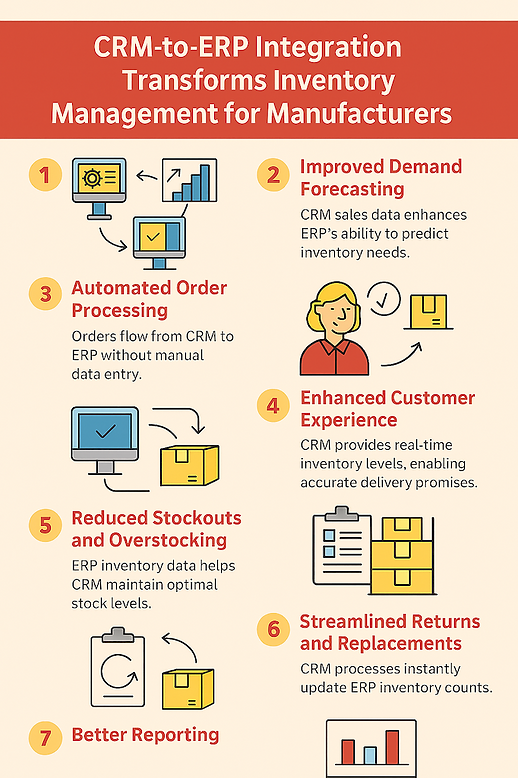
1. Real-Time Inventory Tracking for Manufacturers
When CRM and ERP systems are disconnected, updates in one system often take hours—or even days—to reflect in the other. Integration solves this by synchronizing data in real time.
Example: A sales rep closes an order for 1,000 custom machine parts in the CRM. Without integration, ERP updates might take 24 hours, risking overselling or delaying procurement. With integration, ERP reflects the new demand instantly, enabling procurement to start immediately.
2. Improved Demand Forecasting with ERP and CRM
Manufacturers rely on accurate forecasts to plan raw material purchases and schedule production runs. CRM provides insights into upcoming orders and customer trends, while ERP tracks historical inventory and production data.
Example: CRM shows a spike in inquiries for a new automotive component. ERP uses this data to proactively adjust procurement and production schedules, avoiding last-minute shortages.
3. Automated Order Processing in Manufacturing
Manual data entry between CRM and ERP is error-prone and slows down production scheduling. Automation ensures orders flow seamlessly from sales to manufacturing.
Example: A customer places an order for 500 industrial valves in CRM. Integration triggers ERP to automatically allocate raw materials, schedule production, and update delivery timelines.
4. Enhanced Customer Experience Through ERP Integration
In manufacturing, customers often request precise delivery dates. Sales teams need real-time visibility into production capacity and inventory levels to provide accurate timelines.
Example: A client asks whether 200 custom gear assemblies will be shipped within two weeks. The sales rep checks the CRM, which pulls live data from the ERP, and confirms.
5. Reduce Stockouts and Overstocking in Manufacturing
Overstocking ties up capital and warehouse space, while stockouts halt production and damage customer trust. Integration provides a unified view of inventory across raw materials, WIP (work-in-progress), and finished goods.
Example: Marketing plans a big promotion for a new product line. ERP alerts the team that raw material levels are low, prompting timely reorders before the campaign launches.
6. Streamlined Returns and Replacements
Returns in manufacturing often involve complex processes—inspection, rework, and reintegration into inventory. Integration ensures these updates happen automatically.
Example: A customer returns 50 defective components. CRM logs the return, and ERP updates inventory instantly, triggering quality checks and making usable units available for resale.
7. Better Reporting and Analytics for Manufacturing ERP Integration
Manufacturers need insights into inventory turnover, production efficiency, and regional demand patterns. Combining CRM and ERP data provides a holistic view for strategic decisions.
Example: Reports show high demand for certain machine parts in the Midwest region. The company adjusts inventory distribution and production schedules accordingly, reducing shipping costs and improving delivery times.
Not Just a Technology Upgrade
For manufacturers, CRM-to-ERP integration isn't just a tech upgrade—it's a strategic move that drives efficiency, reduces costs, and improves customer satisfaction. If your manufacturing company is still juggling separate systems and experiences any of the examples shown above, now is the time to consider integration. It's not just about efficiency—it's about staying competitive in a fast-paced market. Let's talk.


Comments